Parker probe data reveal magnetic rotation reversal in solar wind turbulence
Researchers found that magnetic rotation changes direction at the boundary between fluid-like plasma behavior and motion governed by individual particles.
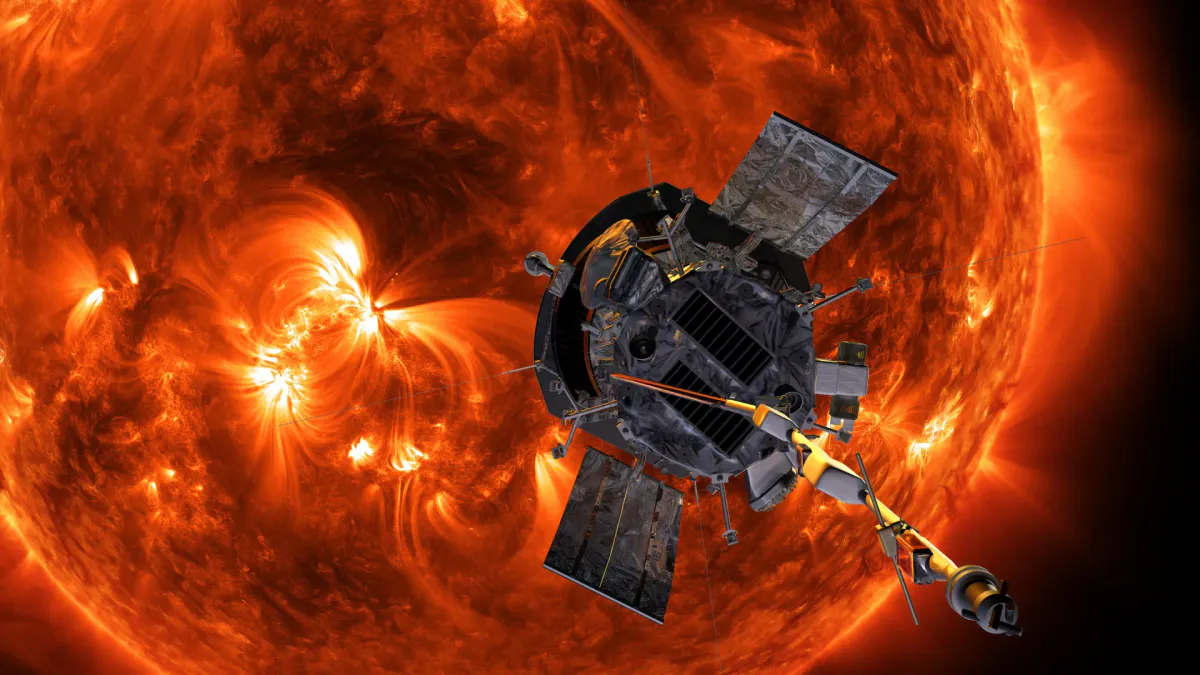
An international team analyzing observations from NASA’s Parker Solar Probe has identified a change in how turbulent magnetic fields rotate in the solar wind. The researchers describe the finding, published in The Astrophysical Journal Letters, as the first direct observation of this reversal in space turbulence.
Looking outward from the Sun, the team found that magnetic rotation generally runs counterclockwise over larger scales but favors a clockwise direction at much smaller scales. The switch coincides with the transition between plasma moving collectively like a fluid and behavior dominated by individual particles.
Measurements of particles and magnetic fields also showed that the reversal grows more pronounced farther from the Sun, shifting to longer wavelengths. The collaboration included scientists from ten countries, with researchers at Technische Universität Braunschweig and the University of Tokyo working alongside colleagues at Tohoku University, Kyushu University, Osaka University and other institutions.
The findings could help explain how turbulence operates across different scales in the solar wind. Such turbulence affects disturbances associated with solar eruptions, which can contribute to geomagnetic storms. The research could also help improve the physical models used for forecasting those storms.