ETH Zurich team tests quantum memory based on mechanical vibrations
An experimental chip combines a superconducting qubit with vibration-based storage, separating information processing from working memory.
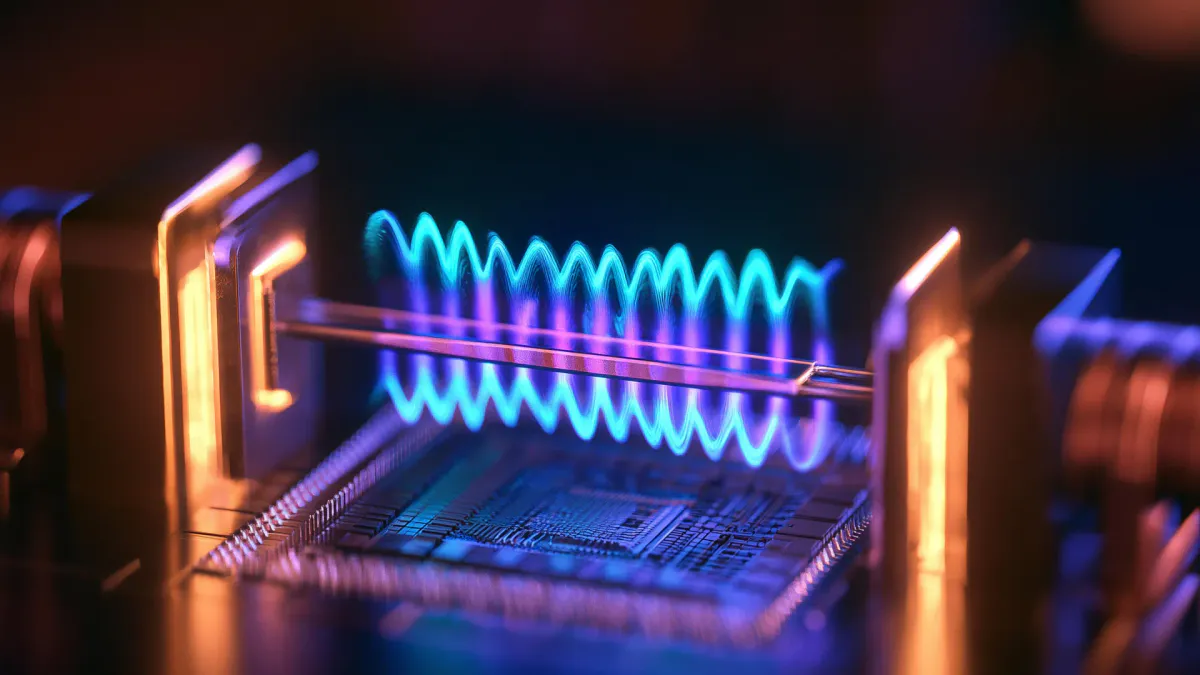
Researchers at ETH Zurich have demonstrated quantum computations using a system that stores information in microscopic mechanical vibrations. The team, led by physicist Yiwen Chu, tested the design with two computational procedures, according to research published in Science.
The architecture assigns processing and control to a superconducting qubit, while separate mechanical resonators hold quantum information as vibration patterns. The qubit retrieves information from that memory, operates on it and sends it back. This division draws on conventional computers, which separate their processors from working memory.
The researchers tested period finding alongside the quantum Fourier transform, procedures that require precise coordination of multiple quantum states. Their experiments showed that the system could preserve the relationships between those states while storing and manipulating information, demonstrating computation rather than storage alone.
According to the researchers, mechanical resonators offer potential advantages over electromagnetic memory: smaller components, multiple vibration patterns for storing information and longer preservation of quantum states. These properties could support more compact systems and calculations involving several processing steps.
The research indicates that the architecture can, in principle, perform the basic operations required for arbitrary quantum computations. Chu's team is investigating further development, with expansion to larger systems remaining a challenge. The approach still needs to maintain precision and reliability as components and computational complexity increase.