
Lumina simulation tracks how early galaxies transformed cosmic gas
Researchers modeled hydrogen and helium re-ionization together, finding that stars and feeding black holes played different roles.
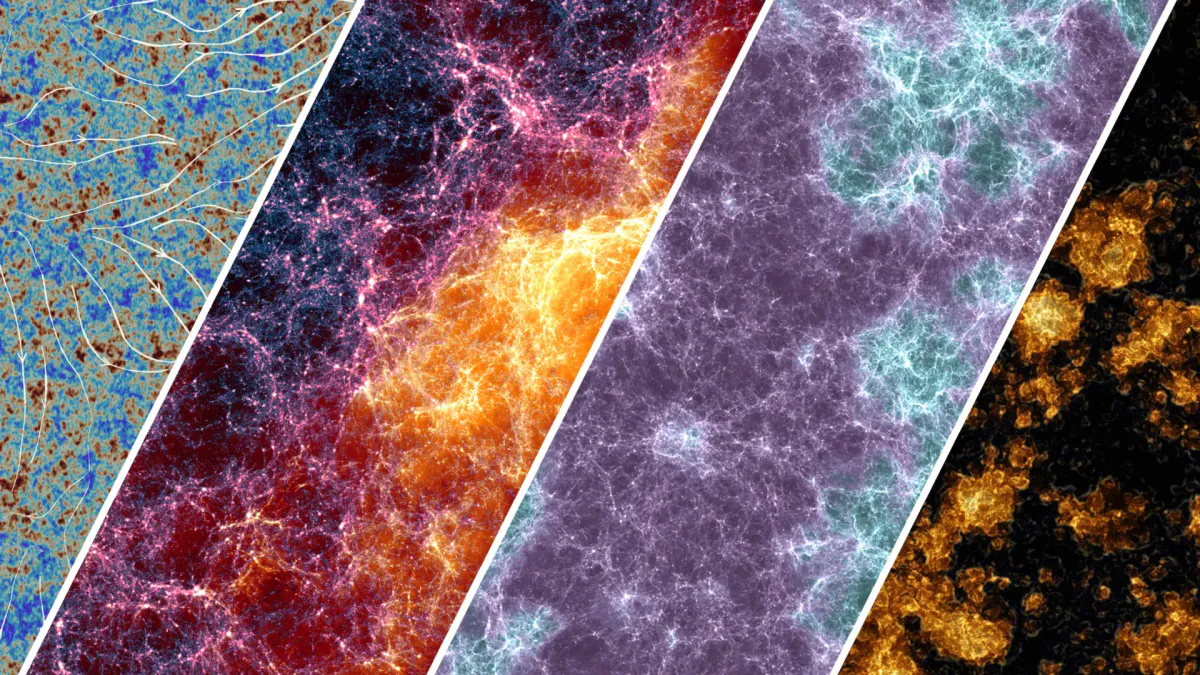
A team involving MIT, Harvard University and other institutions has created a simulation called Lumina to investigate how galaxies and radiation reshaped the early universe. It models 2 billion years within a space spanning 500 megaparsecs, or approximately 1.6 billion light-years.
Findings published in Monthly Notices of the Royal Astronomical Society suggest that the earliest stars and galaxies supplied most of the radiation that ionized hydrogen. Supermassive black holes feeding on matter supplied the more energetic radiation required to ionize helium.
These processes remove electrons from atoms. As hydrogen became ionized, ultraviolet light could travel farther through space. The researchers say Lumina is the first simulation to capture hydrogen and helium re-ionization together.
The team adapted the IllustrisTNG software, adding calculations that follow light as it moves through matter. Approximately half a trillion elements represent gas, dark matter and other components. Computing work used Frontier, a supercomputer based at Tennessee's Oak Ridge National Laboratory.
The researchers are opening Lumina to other scientists so its simulated galaxy populations can be tested against telescope observations. They also plan to study the early universe's large-scale distribution of matter.