
Webb observations reveal three active black holes sharing a distant galaxy
Two of the objects form a close central pair, while a smaller black hole is gathering matter faster than basic growth models predict.
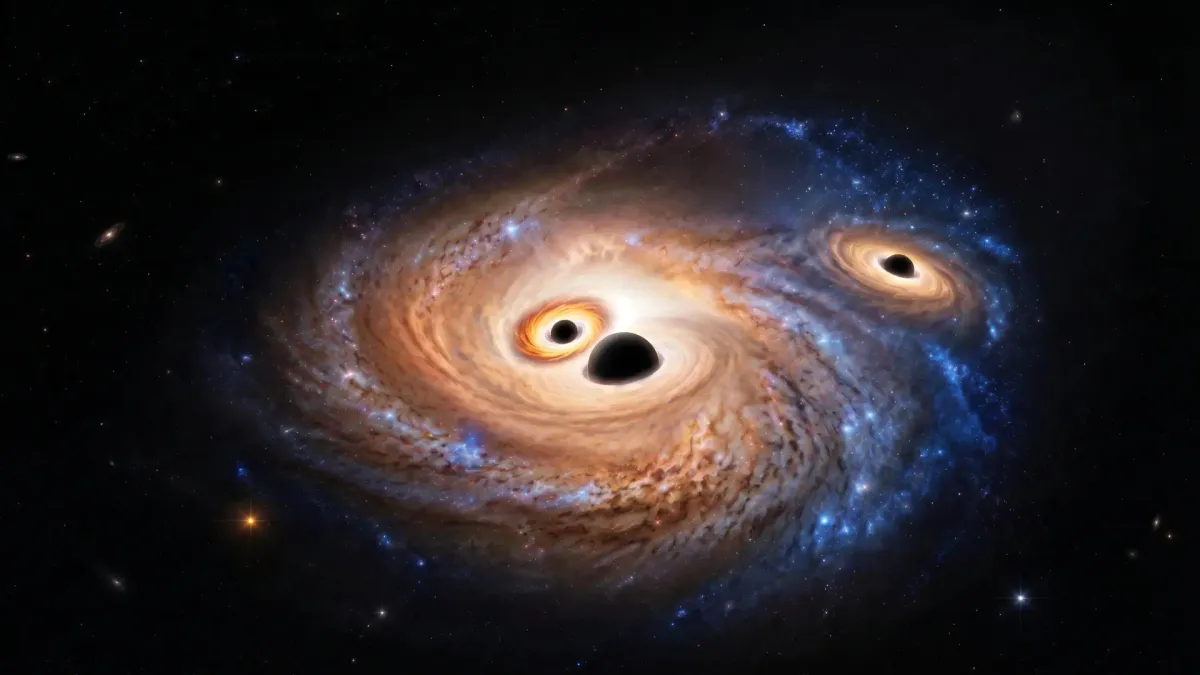
Observations with the James Webb Space Telescope have revealed a trio of growing supermassive black holes in J0148-4214, researchers report. The galaxy lies more than 12.5 billion light-years from Earth, and astronomers see it at an age of just 1.2 billion years after the Big Bang.
Hannah Übler, the study's lead author and a research group leader at the Max Planck Institute for Extraterrestrial Physics (MPE), said no previous evidence had established three active black holes sharing one galaxy in the distant universe. MPE led the international research team.
The central pair has a projected separation measuring 620 light-years. The remaining object sits approximately 5,500 light-years away from the galaxy's center. Researchers expect the inner two to merge over the coming few hundred million years.
Hydrogen emissions provided the clues: fast-moving gas produces distinctive spectral patterns near black holes. The team concluded that two nearby objects best accounted for the complicated central signal.
Webb could not resolve the central objects individually. Instead, researchers traced small positional changes in spectral emissions using spectro-astrometry. Observations with Webb's Near Infrared Spectrograph also distinguished the outer object.
The researchers put the three masses at approximately 80 million, 600,000, and 2 million times the Sun's mass. The black hole weighing roughly 600,000 suns is gathering material faster than its larger neighbor. Its estimated feeding rate surpasses the Eddington limit, the maximum predicted by basic growth models.