AI learners build vocabularies by revisiting children's daily speech
A Princeton study found that replaying recent recordings helped artificial learners retain language patterns, though the models did not understand word meanings.
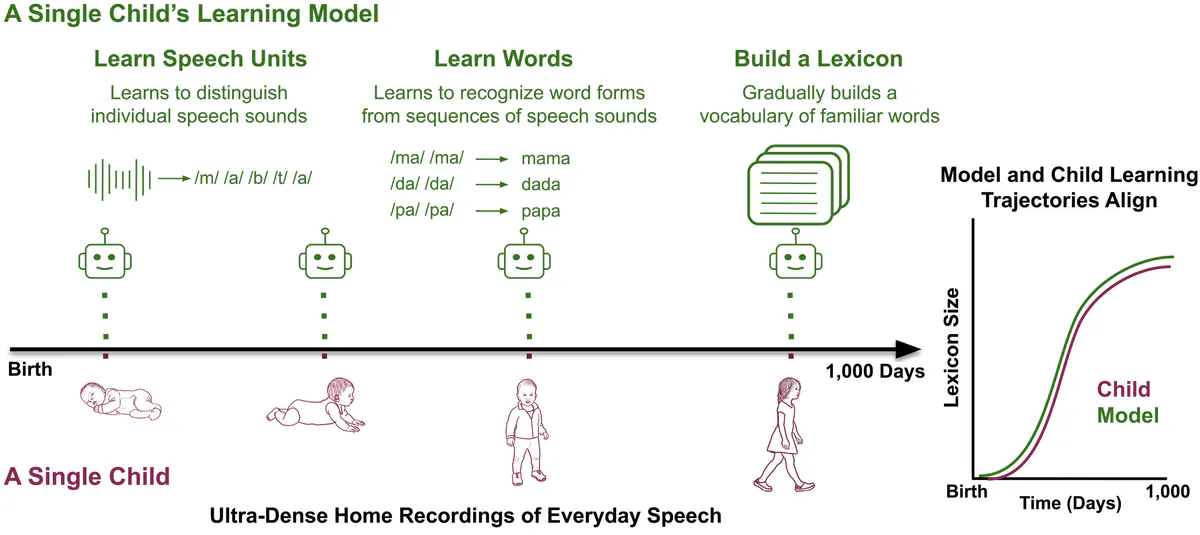
Artificial language learners developed vocabularies containing thousands of words when they repeatedly reviewed speech recorded around individual children, Princeton University researchers reported in Science. Without that review, the first model tested retained little between simulated days and learned no words by the equivalent of the child's second birthday.
The research used recordings from eight children participating in the 1,000 Days Project. The larger project placed recording equipment in 15 homes, documenting daily experiences from birth to roughly age 3. Each artificial learner received one child's speech recordings in chronological order, without text or prior knowledge of speech sounds or word boundaries.
Researchers added a review period after each simulated day, drawing mainly on recordings from the preceding few days. Inspired by memory replay during sleep, this step was not intended to recreate sleep's full biological complexity.
With replay, the first model identified units corresponding to nearly all English phonemes and began recognizing recurring words, the researchers said. Applying the same settings to the other seven children's recordings also produced vocabularies containing thousands of words.
However, those models learned at broadly similar speeds, unlike the children themselves. To reproduce individual developmental timing, the team varied three settings: the amount of nightly replay, learning speed and the point at which word learning began.
The researchers emphasized that their system does not understand word meanings and lacks a child's body, social motivations and brain biology. They described the approach as a way to test proposed learning mechanisms against children's recorded experiences, rather than an attempt to achieve superhuman AI performance.