AI model speeds calculations of light interactions in lasers
A neural network reproduced complex pulse behavior, with batched GPU processing reducing average simulation time to a few milliseconds.
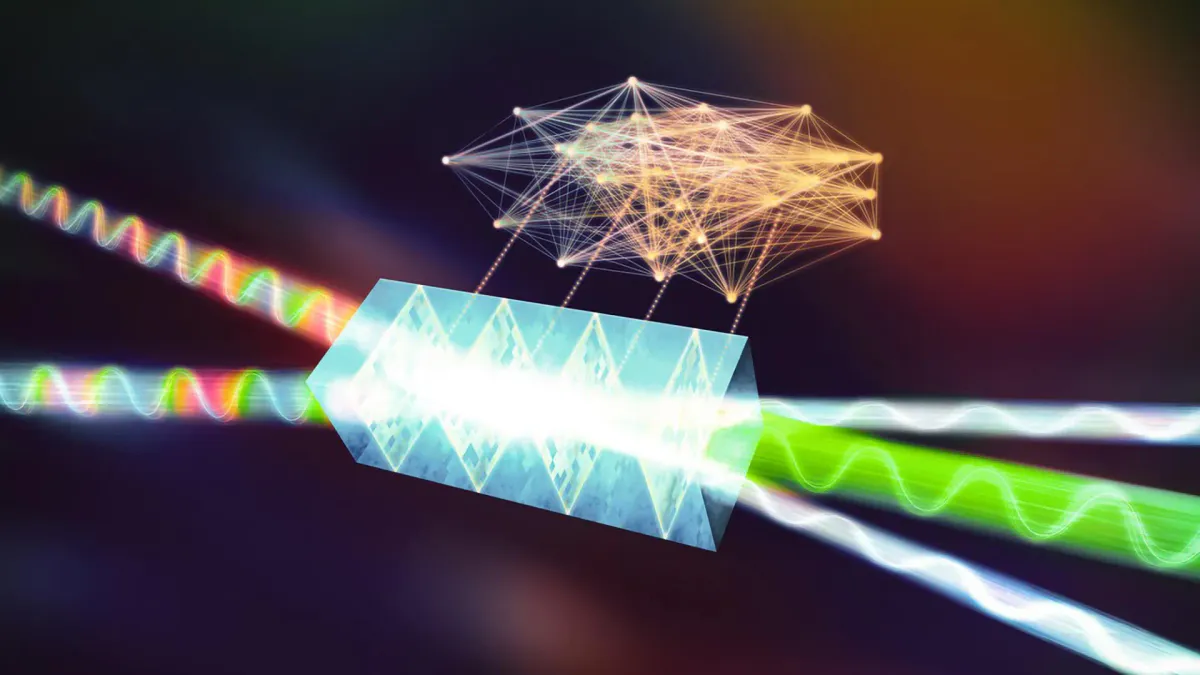
An artificial intelligence model can reproduce calculations of interacting laser pulses in a few milliseconds per simulation when multiple simulations are processed together on graphics processing units, researchers reported in Advanced Photonics. Their tests found that the model retained accuracy across varied pulse shapes.
The work brought together scientists from Stanford University, the University of California, Los Angeles (UCLA), and SLAC National Accelerator Laboratory. They targeted second-order nonlinear optics: interactions within specially designed crystals that let scientists change light frequencies and shape pulses. Conventional calculations for these interactions consumed approximately 95 percent of processing time in the full laser simulation they studied.
The researchers adapted a long short-term memory neural network to follow three interacting light fields within a crystal. It operates on compressed frequency information, avoiding the repeated conversions between time and frequency representations required by the conventional method. Tests included pulses with pronounced spectral gaps and strong optical phase variations.
Frequency conversion is part of the laser system at SLAC’s LCLS-II facility. There, infrared pulses become green and then ultraviolet light. The ultraviolet pulse strikes a cathode to release electrons, which are subsequently accelerated and manipulated to produce X-rays.
The team envisions linking separately trained networks to predict an entire experimental system’s behavior during operation. Possible applications include digital twins of laser equipment and adaptive control, but these remain prospective uses.