Voyager 1 becomes first spacecraft one light-day from Earth
The NASA probe reached the milestone on November 18, roughly nine years before Voyager 2 will reach the same distance.
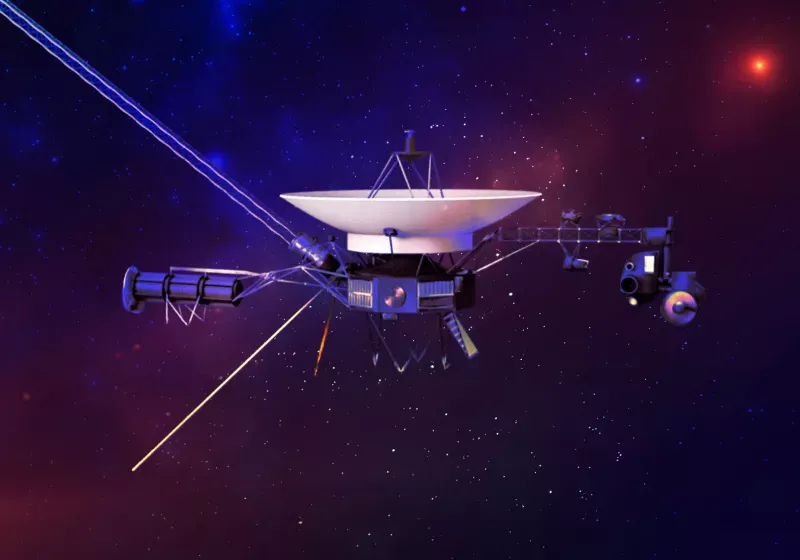
NASA’s Voyager 1 reached a point one light-day away from Earth on November 18 at 5:16:07 a.m. Eastern time, becoming the first human-made object to do so. The spacecraft has been traveling since its launch in 1977.
A light-day measures how far light moves over 24 hours: 16,094,799,096 miles (25,902,068,356 kilometers). Light travels at approximately 186,000 miles per second. By comparison, sunlight needs about eight minutes and 20 seconds to reach Earth across a distance of 93 million miles.
The Voyager program began with missions to study the outer planets, including Jupiter and Saturn. Voyager 1 launched on September 5, while Voyager 2 departed earlier, on August 20. After finishing its planetary objectives, Voyager 1 began an extended mission in 1980.
In 2012, Voyager 1 became the first human-made object to enter interstellar space. Voyager 2 reached interstellar space in 2018; no other spacecraft have done so. It will reach the one-light-day distance roughly nine years after Voyager 1.