
Australian researchers send gravity signal through brick wall with old elevator
The University of Queensland experiment delivered a single word over about 70 centimeters, at a rate of one bit per minute.
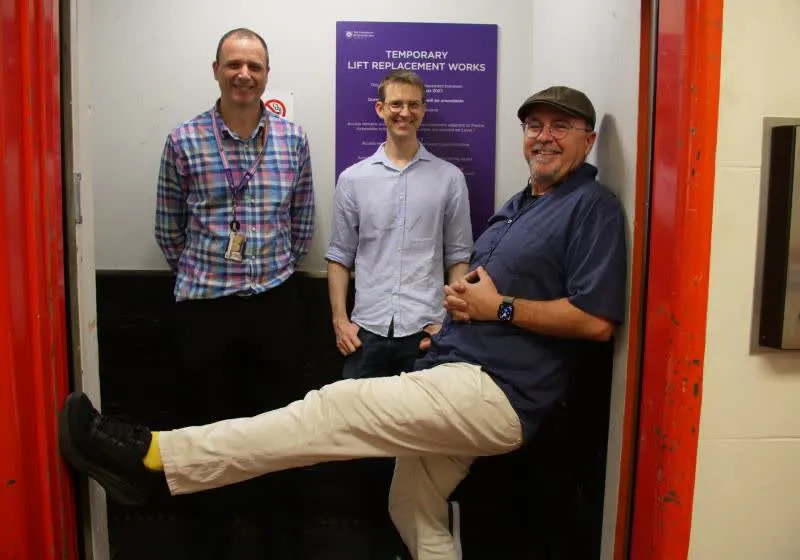
An elevator dating to the 1950s has helped University of Queensland physicists transmit the word “Gravity” through a brick wall. The researchers detected small gravitational variations produced by its counterweight, sending information about 70 centimeters to a nearby instrument.
The demonstration achieved one bit per minute. With each counterweight movement taking about 25 seconds, transmitting the 49 bits needed to represent “Gravity” using seven-bit ASCII required nearly an hour of elevator operation.
Located in the university’s Parnell Building, the elevator has a counterweight weighing 1.8 metric tons that travels in the direction opposite to the car. The team assigned binary values of 0 and 1 to two counterweight positions. A commercially available gravimeter in an adjacent bathroom detected the resulting gravitational changes through the wall, measuring variations of five billionths of normal gravitational strength.
The researchers outlined possible applications in Science Advances, including communication with sealed nuclear bunkers. No known material can shield gravity, unlike radio waves or light, which can be blocked by materials such as metal or rock.
Their modeling also explored combining a heavier mass with quantum sensors that measure gravity using atom clouds. That arrangement could potentially extend transmission to around 500 meters (1,640 feet), although the team acknowledged that the estimate relied on ambitious assumptions.