Japanese and European probes reach Mercury orbit after eight-year journey
The BepiColombo probes are due to separate around Dec. 10, with full-scale scientific observations expected to start around April.
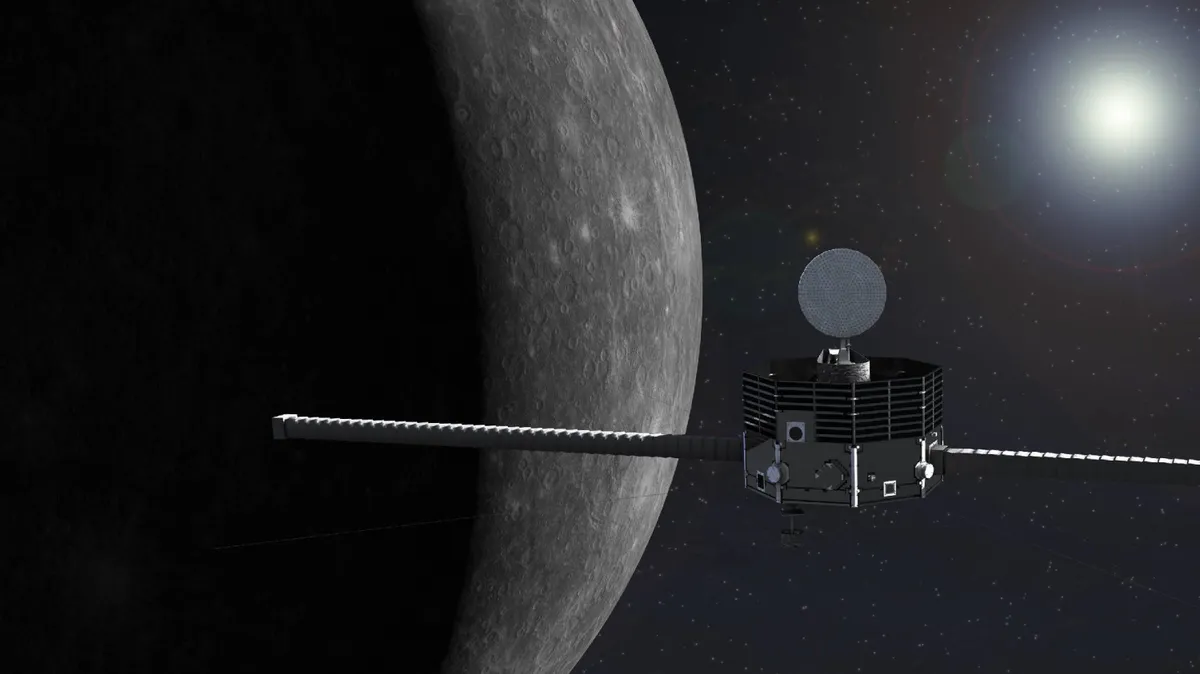
Two spacecraft sent by Japan and Europe have reached orbit around Mercury after traveling for eight years, the European Space Agency said. The BepiColombo mission will investigate the planet’s magnetic field and atmosphere.
The spacecraft have different scientific roles: Mio, from the Japan Aerospace Exploration Agency (JAXA), observes magnetic fields, while ESA’s MPO studies conditions on Mercury’s surface. They were joined together for their launch in October 2018 and are scheduled to separate around Dec. 10.
Problems with the propulsion system pushed the arrival back by about a year from the original December 2025 schedule. Full-scale scientific observations are expected to get underway around April.
Mercury, the solar system’s innermost planet, poses technological challenges for orbiting spacecraft because of the sun’s intense heat and strong gravitational pull. The arrival follows the U.S. Messenger probe, which entered Mercury’s orbit in March 2011.