
Study identifies source of drag on laser-driven sails at extreme speeds
Calculations suggest scattered light could resist a sail’s motion near 75% of light speed, although the laser would still provide net forward thrust.
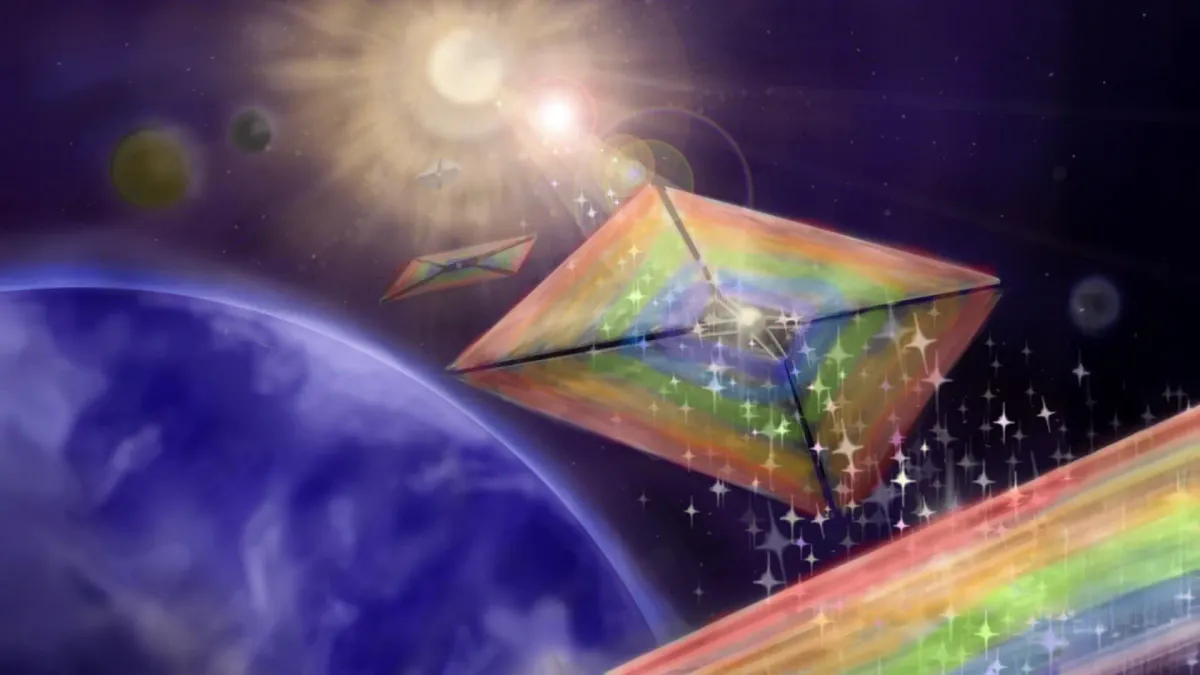
Light scattered by a laser-driven solar sail could begin resisting its motion at approximately 75% of light speed, according to research by Chao Shen and Jiaze Li of the Harbin Institute of Technology. Their calculations indicate that the laser would still push the spacecraft forward overall, but with reduced efficiency.
The paper, available on arXiv, examines momentum transferred by incoming photons, mirror-like reflection and diffuse scattering, in which absorbed light is reemitted in random directions. Of those three contributions, the researchers found diffuse scattering to be the weakest.
At sufficiently high speeds, an effect called relativistic light aberration changes the apparent direction of the scattered light. To an observer stationary on Earth, more of that light travels forward, producing recoil that acts against the sail’s motion, the study found.
The researchers also describe a broader loss of thrust as the sail moves away from its laser. Incoming light shifts to lower frequencies from the sail’s perspective, making momentum transfer less effective across all three interactions.
The calculations use an idealized mirror and exclude resistance from interstellar gas and dust, along with heating challenges posed by powerful lasers. The work addresses propulsion concepts such as Breakthrough Starshot, which envisioned sending tiny spacecraft toward nearby stars using laser beams.