Anduril says first satellite can track spacecraft through orbital darkness
The company wants to sell tracking data to the US military, but has not publicly shown a target maneuvering in darkness.
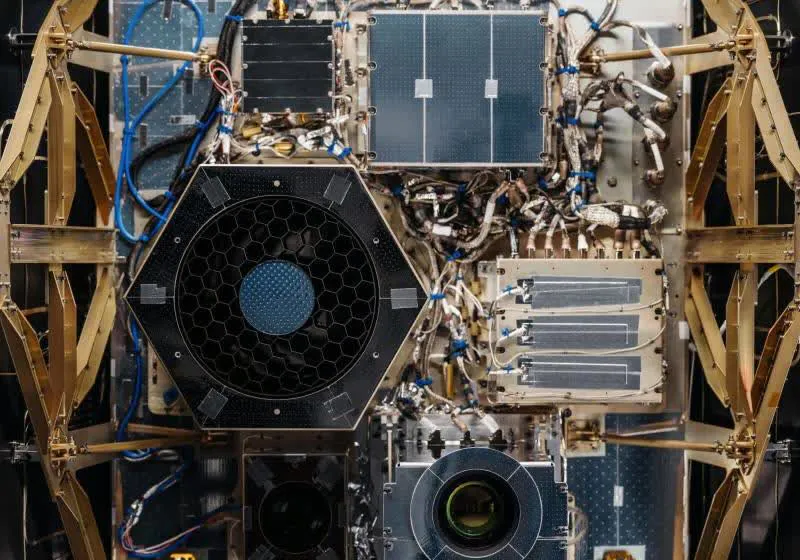
Anduril says its first satellite can detect spacecraft while they pass through Earth's shadow, using an infrared sensor that measures emitted heat rather than reflected sunlight. Anduril-216 reached orbit in July aboard a SpaceX rideshare flight.
The spacecraft operates at about 590 km (366 miles) above Earth and spends around a third of each orbit without sunlight. Anduril says its long-wave infrared imaging technology was adapted from autonomous weapons. Orbital systems chief Adam Thurn told Ars Technica that it allows the company to observe adversaries maneuvering during eclipse periods.
Public evidence remains limited: Anduril has shared an infrared image showing the Moon above Earth's horizon, but has not demonstrated a target changing course in darkness. Thurn said the sensor could produce detailed images of satellites at sufficiently close range.
Two visible-light cameras supplied by outside companies also fly aboard Anduril-216. An onboard computer combines their imagery with infrared observations and independently calculates tracking solutions, without waiting for ground-based analysts.
Engineering head Gokul Subramanian said Anduril prefers selling tracking data to the US military over selling satellites and does not plan its own satellite production line. Startup Apex Space supplied the satellite body, while Anduril provided its payload.
Anduril also bought ExoAnalytic in March, adding a network of around 400 telescopes monitoring higher-orbit spacecraft. The same infrared imager is scheduled to travel to geostationary orbit on an Impulse Space spacecraft for a planned close-inspection demonstration.