
Startup claims efficiency gains for AI-designed Frostbite processor
Architect Labs says its agents developed a new CPU architecture, but the design has not been fabricated and its power figures come from models.
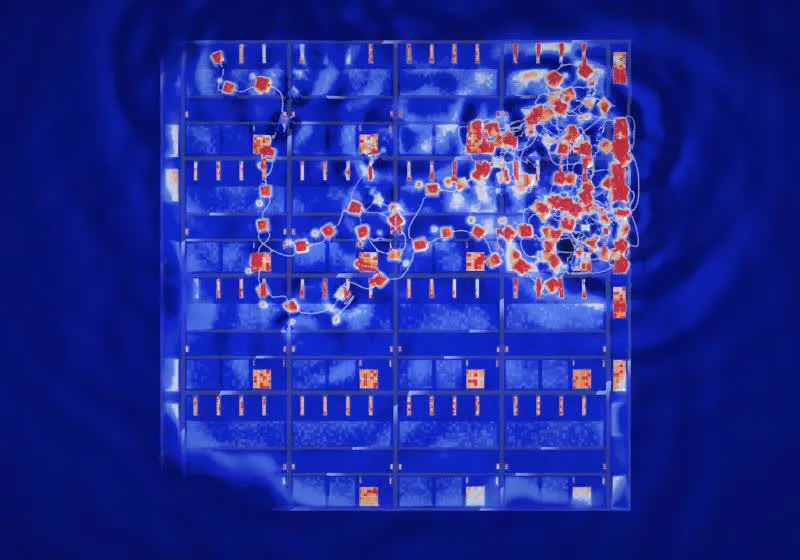
Palo Alto startup Architect Labs says a four-tile configuration of its AI-designed Frostbite processor achieved average efficiency of 4.59 times that of a conventional CPU core in modeled tests. The company has not fabricated the design, so the power results do not come from physical chips.
The reported advantage varied between test groups. Efficiency reached 6.02x on ten programs used to tune the architecture, compared with 3.83x on 15 programs withheld until final testing. Architect Labs declined to identify the comparison core for legal reasons; it is a simple in-order design resembling smaller cores used for background work in phone chips.
According to the company, humans selected 25 test programs, but the agents began without an existing processor design. They reviewed research and benchmarks and built Python prototypes before choosing interaction nets, a computing approach introduced in 1990 that allows multiple operations to proceed in parallel.
Development included a setback: the team discarded an initial 141-page specification after circuit-design work revealed physically impossible figures. Groups of agents subsequently proposed revisions and checked them using a fast software model. The resulting architecture divides processing among tiles that take work from busy neighbors and shut down when none is available.
Frostbite cannot run existing x86 or Arm software. Programs instead use Vine, a Rust-like language developed by Cambridge startup Tendrils Compute. Architect Labs plans to make an FPGA-hosted environment available for people to run programs on the architecture.