Impossible OS targets Windows and Linux apps, with alpha set for 2028
South African developer Derick Payne is working alone on the x86-64 operating system, which has its own kernel and bootloader.
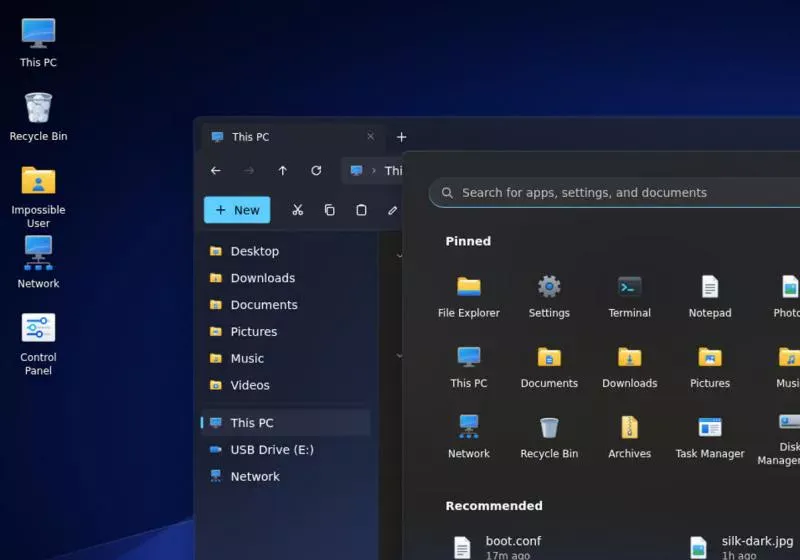
Derick Payne, a developer and entrepreneur based in South Africa, has introduced Impossible OS, a PC operating system intended to support both Windows and Linux software. Payne says an initial public alpha is scheduled for August 8, 2028.
The project's manifesto describes native compatibility with Win32 applications as a goal, alongside support for Linux binaries. Payne says Impossible OS is an independent operating system, not a Linux distribution, and includes its own ring-0 kernel, UEFI bootloader and graphical desktop.
The Windows 11-inspired project is described as entirely open source. Its design uses the kernel's native API for Win32 compatibility, while a compatibility layer is planned to handle Linux ELF binaries. The original codebase will use C alongside x86-64 assembly, with existing open-source libraries adapted where creating replacements would be impractical.
Impossible OS currently has 1,443,321 lines of code and appears able to boot on physical hardware and show a desktop. Payne is developing it alone and acknowledges that a single developer is unlikely to outperform a corporate engineering team anytime soon.