
Microscopy platform captures deep-brain activity in mice without tissue removal
Researchers report that redesigned laser delivery improved fluorescence generation efficiency roughly 250-fold while keeping average laser power unchanged.
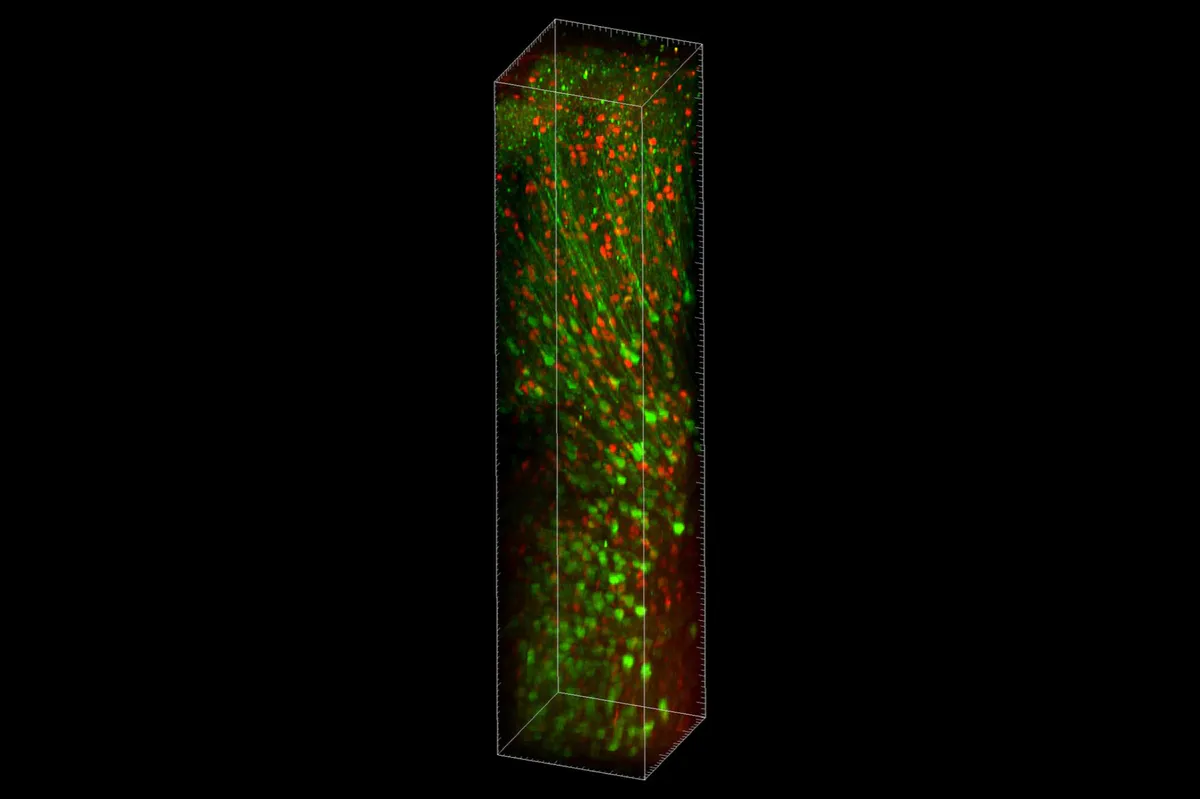
Researchers at Rockefeller have recorded activity from individual neurons as deep as 2.1 millimeters inside mouse brains using a redesigned microscopy system. Their findings, published in Nature Methods, describe access to parts of the hippocampus and striatum while leaving the cortex above those structures intact.
The platform, Three-photon Ultra-Deep Imaging (TrUDI), addresses a constraint on optical brain imaging: tissue scatters incoming light, weakening the distinction between neuronal signals and background fluorescence. Increasing laser power to compensate can overheat tissue and cause damage.
Computer models helped the team redesign the system’s optics and laser settings. The researchers increased the energy of each pulse but reduced pulse frequency, holding average power steady. They also changed how light is focused and collected. Together, the modifications yielded roughly 250-fold greater fluorescence generation efficiency, the team reported.
A scanning approach limits laser activation to identified neurons rather than illuminating the full scanning path. According to the researchers, that reduced exposure by up to 80% in lengthy imaging sessions. Tissue examinations under the conditions tested detected neither inflammation nor neuronal loss, and found no DNA damage.
Alipasha Vaziri, head of the Laboratory of Neurotechnology and Biophysics, said earlier functional recordings had reached about 1.2 millimeters. He cautioned that some striatal regions remain inaccessible and that deeper brain nuclei still need invasive methods.