KAIST team develops method to extend anode-free battery life
Researchers combined microscopic copper structures with an ultrathin coating to control lithium buildup, potentially supporting smaller electric vehicle batteries.
Researchers in South Korea have developed a method that could make anode-free batteries last longer without substantially increasing their weight or size, KAIST announced on September 22. The approach uses semiconductor fabrication techniques to help lithium build up evenly, potentially supporting more compact electric vehicle batteries.
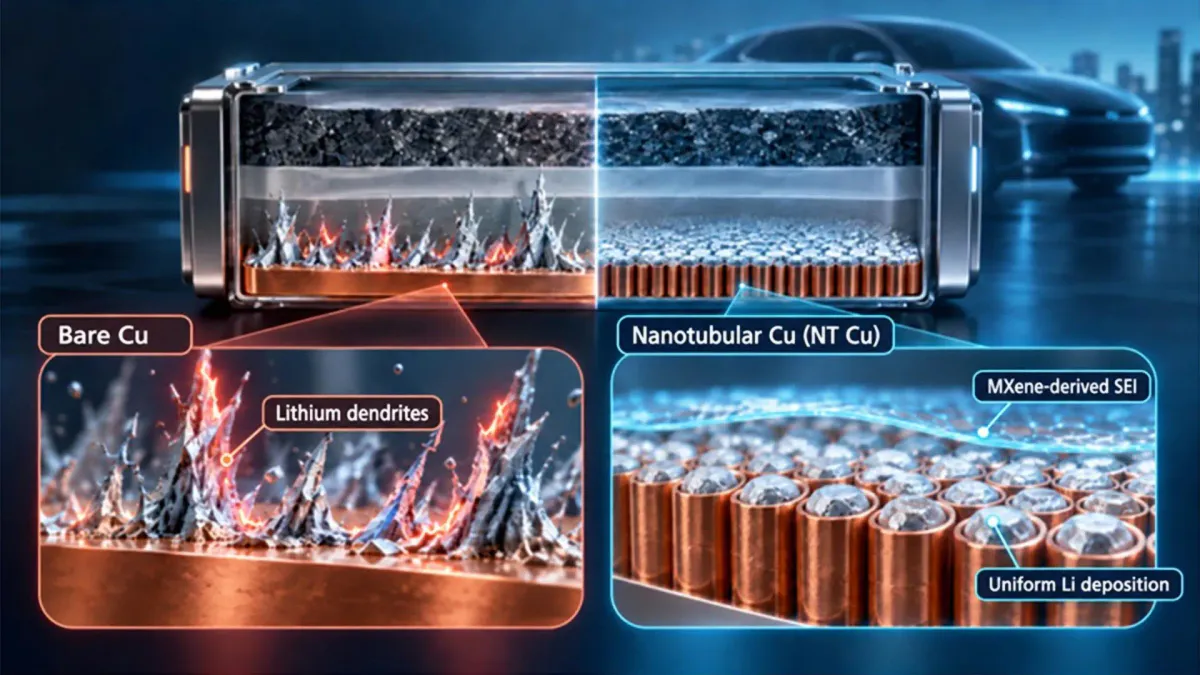
Anode-free batteries dispense with conventional anode materials such as graphite, depositing lithium onto copper foil instead. That design can hold more energy in a given space, but uneven lithium buildup can produce needle-like structures called dendrites. These structures and an unstable protective layer contribute to battery deterioration.
The team patterned the copper with microscopic tubes using secondary sputtering lithography, a semiconductor manufacturing technique. The tubes were approximately 300 nanometers wide and 150 nanometers high. They provided roughly four times the surface area available on flat copper, helping lithium spread more evenly.
Researchers also added an approximately 10-nanometer-thick coating of MXene, a two-dimensional material. In experiments using a LiPF6-based electrolyte, it encouraged a protective layer rich in lithium fluoride to form. The researchers found that this layer helped curb unwanted chemical reactions and the growth of lithium spikes.
KAIST Professors Jinwoo Lee and Hee-Tae Jung led the collaboration, which included Kyungpook National University and the National NanoFab Center. Lee said the findings could advance commercialization of high-energy anode-free batteries. The study appeared online in Advanced Functional Materials on September 1.