
Harvard-led team boosts ultraviolet output from tiny photonic device
The chip-based device produced 4.2 milliwatts of ultraviolet power, a result researchers say could support smaller quantum computers and precision sensors.
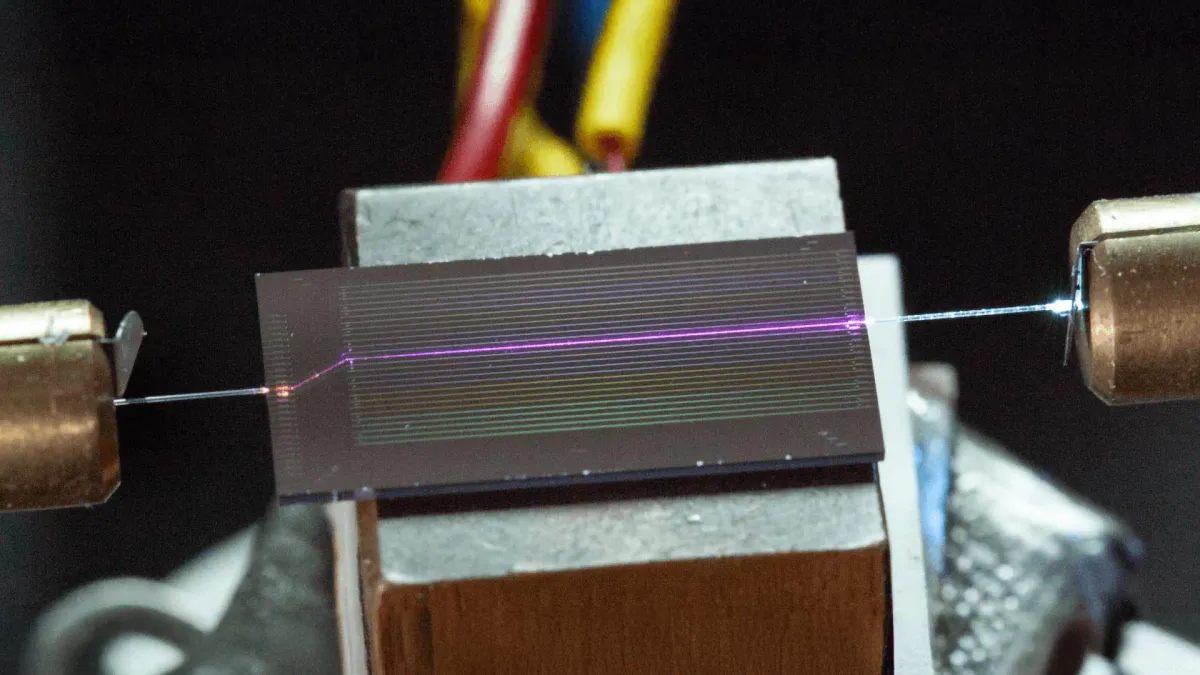
A Harvard-led team has demonstrated a microscopic device that generates ultraviolet light with approximately 120 times the power of earlier comparable devices. The researchers reported an output of 4.2 milliwatts at a wavelength of 390 nanometers using thin-film lithium niobate.
The findings, published in Nature Communications, describe a way to produce ultraviolet light inside a photonic chip by converting red light. Generating UV within the device addresses a challenge facing compact light sources: ultraviolet light quickly loses power while traveling through the microscopic channels known as optical waveguides.
Working in Marko Lončar’s laboratory, the team developed a fabrication method called “sidewall poling.” It places patterned metal electrodes alongside an etched waveguide, allowing an applied voltage to reverse the orientation of crystal regions across its full cross section. The researchers also adjusted the spacing between those regions to compensate for variations in film thickness and waveguide shape, improving light conversion.
The researchers said the higher output could help shrink light sources for trapped-ion quantum computers, which use charged atoms to process and store quantum information. They also identified potential uses in atomic clocks and compact sensors for greenhouse gases and atmospheric pollutants. Earlier lithium niobate experiments produced only tens of microwatts of UV power, an output insufficient for practical applications.