
Lighter nuclei yield evidence of early-universe plasma at LHC
Results from four research collaborations challenge the view that producing quark–gluon plasma requires collisions involving very heavy nuclei.
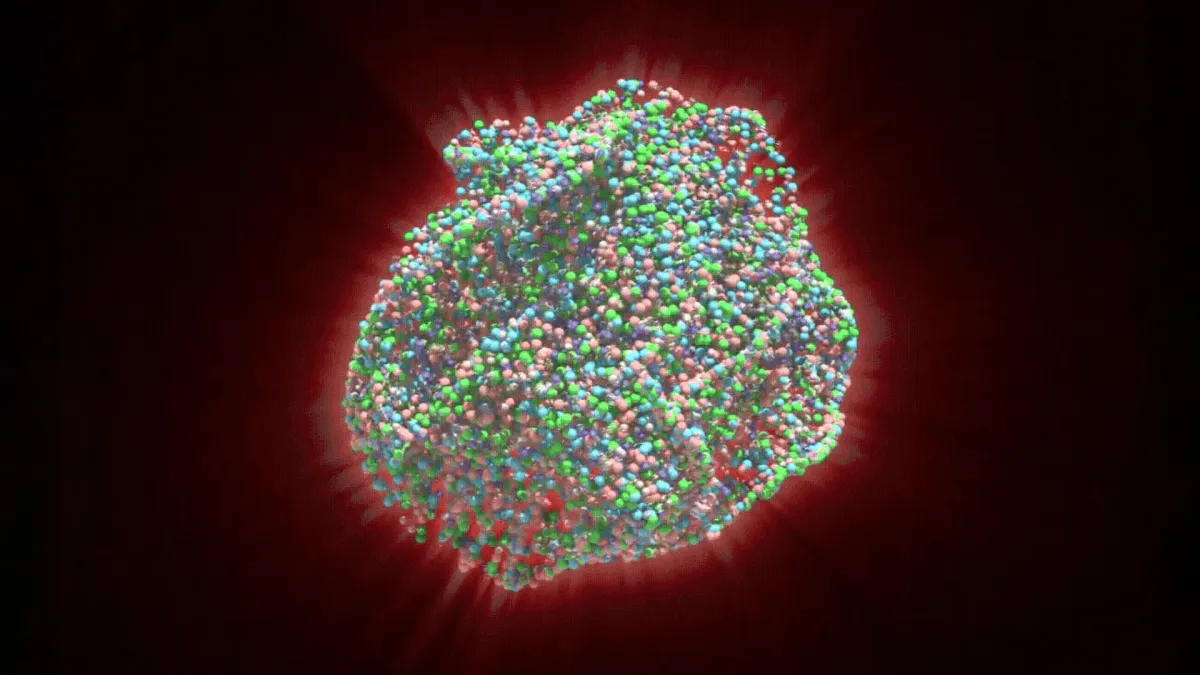
Four collaborations at the Large Hadron Collider (LHC) have reported evidence suggesting that quark–gluon plasma can emerge in experiments colliding oxygen nuclei or neon nuclei. The findings from ALICE, ATLAS, CMS and LHCb strengthen indications that lighter nuclei can produce conditions previously thought to require heavy nuclei such as lead.
Physicists believe this plasma existed throughout the universe shortly after the Big Bang. Extreme heat and pressure separate the quarks and gluons that normally form protons and neutrons.
ALICE investigated whether energy loss could explain reduced particle production by comparing neutral pions from oxygen–oxygen collisions with those from proton–oxygen collisions. The collaboration reported unambiguous evidence that quarks and gluons lost energy in the oxygen–oxygen system. Reduced production alone is not conclusive, because other processes can cause similar effects.
ATLAS found unequal energies in paired particle jets produced by oxygen and neon collisions, indicating energy loss as particles crossed the surrounding material. More direct impacts showed a stronger effect, consistent with expectations that these collisions create more plasma.
CMS measured lower charged-particle production in both systems than in proton–proton collisions. LHCb, examining particles made of a charm quark and a lighter quark, observed greater suppression with neon than with oxygen.
Separately, preliminary ALICE results identified a stronger directional preference among three-quark particles than among two-quark particles in oxygen collisions. Researchers consider that pattern another possible indication of plasma formation and are continuing to analyze data from lighter nuclei.