
Astronomers improve precision of primordial helium measurement
A study of 15 distant galaxies reduced uncertainty to 0.5%, offering a sharper test of the Standard Model of physics.
Astronomers say they have determined the abundance of helium created within five minutes of the Big Bang with three times the precision of previous estimates. The international collaboration, which includes University of Minnesota Twin Cities scientists, reports an uncertainty of 0.5%.
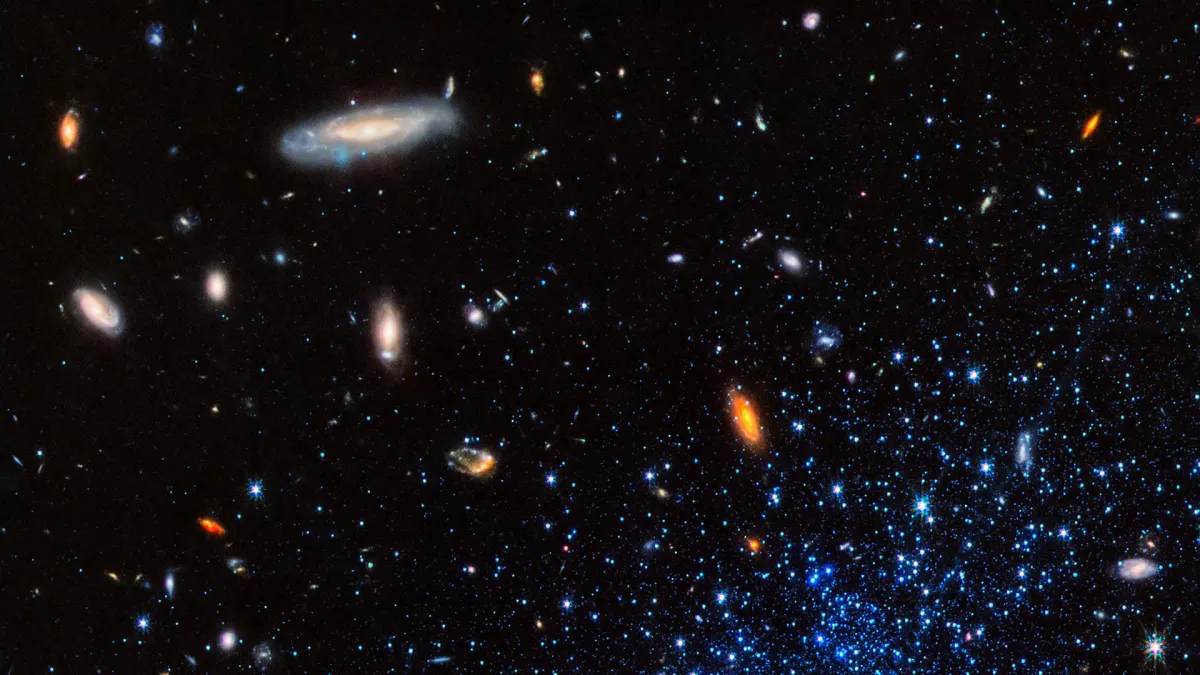
Five papers in The Astrophysical Journal describe the findings, drawing on telescope observations lasting 130 hours. The team used the Large Binocular Telescope to study 15 small galaxies at great distances whose chemistry has undergone relatively little change.
The selection offered an alternative to the usual approach: surveying numerous galaxies and extrapolating backward to estimate helium abundance before successive generations of stars changed their composition. The researchers instead concentrated on galaxies that retain more evidence of their early chemical makeup.
Instruments built at Ohio State University captured more than 10 spectral lines from helium alongside 15 from hydrogen. Analyzing both sets together helped the team identify and correct small errors. Those effects matter particularly when measurement uncertainty drops below 1%, the researchers said.
The team says the result can help test the Standard Model because primordial helium production depended partly on which elementary particles were present. Researchers also calculated how many families of neutrinos—extremely light subatomic particles—existed in the early universe, using the helium measurement.