
Astronomers detect nearby triple-star system with two white dwarfs
The system, named Welopōʻai, lies 27.6 light-years from Earth, and researchers have yet to explain how its three stars came together.
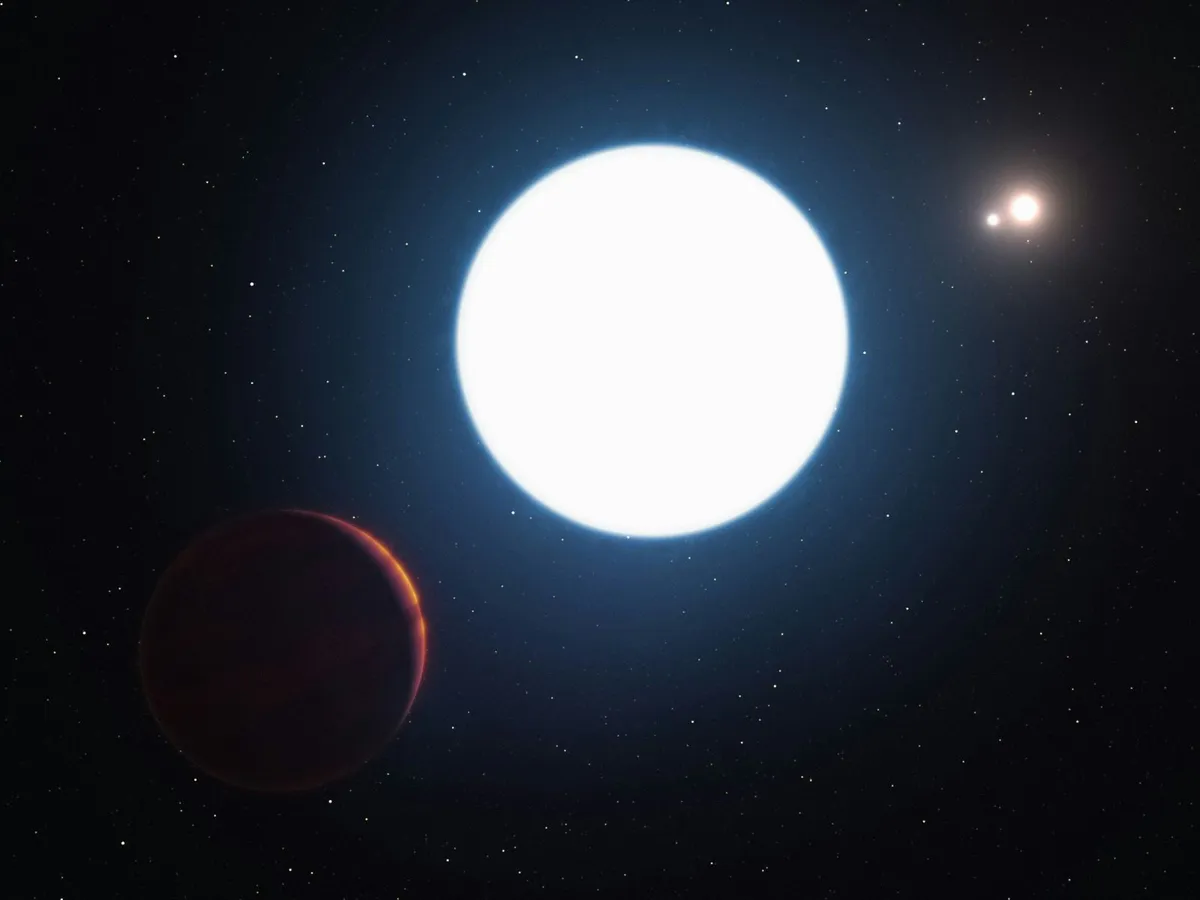
A team led by the University of Montreal’s Trottier Institute for Research on Exoplanets (IREx) has identified a three-star system 27.6 light-years from Earth. Named Welopōʻai, it contains a red dwarf and two white dwarfs, according to the researchers.
The discovery began with measurements from SPIRou, an instrument at the Canada-France-Hawaii Telescope that searches for exoplanets through changes in stellar velocity. Astronomers noticed unusual behavior in the red dwarf TYC 3980-1081-1: its velocity varied by about 10 miles per second, or 16 kilometers per second.
Observations with the Gemini North telescope then revealed a faint companion, identified by the astronomers as a white dwarf. That star and the red dwarf orbit relatively near one another, while the system’s other white dwarf is farther away.
The researchers have not established how the system formed. Patrick Dufour said there was no clear explanation for its existence and that further observations would investigate that question. The gravitational interactions among the three stars also remain poorly understood and are due for further study.